
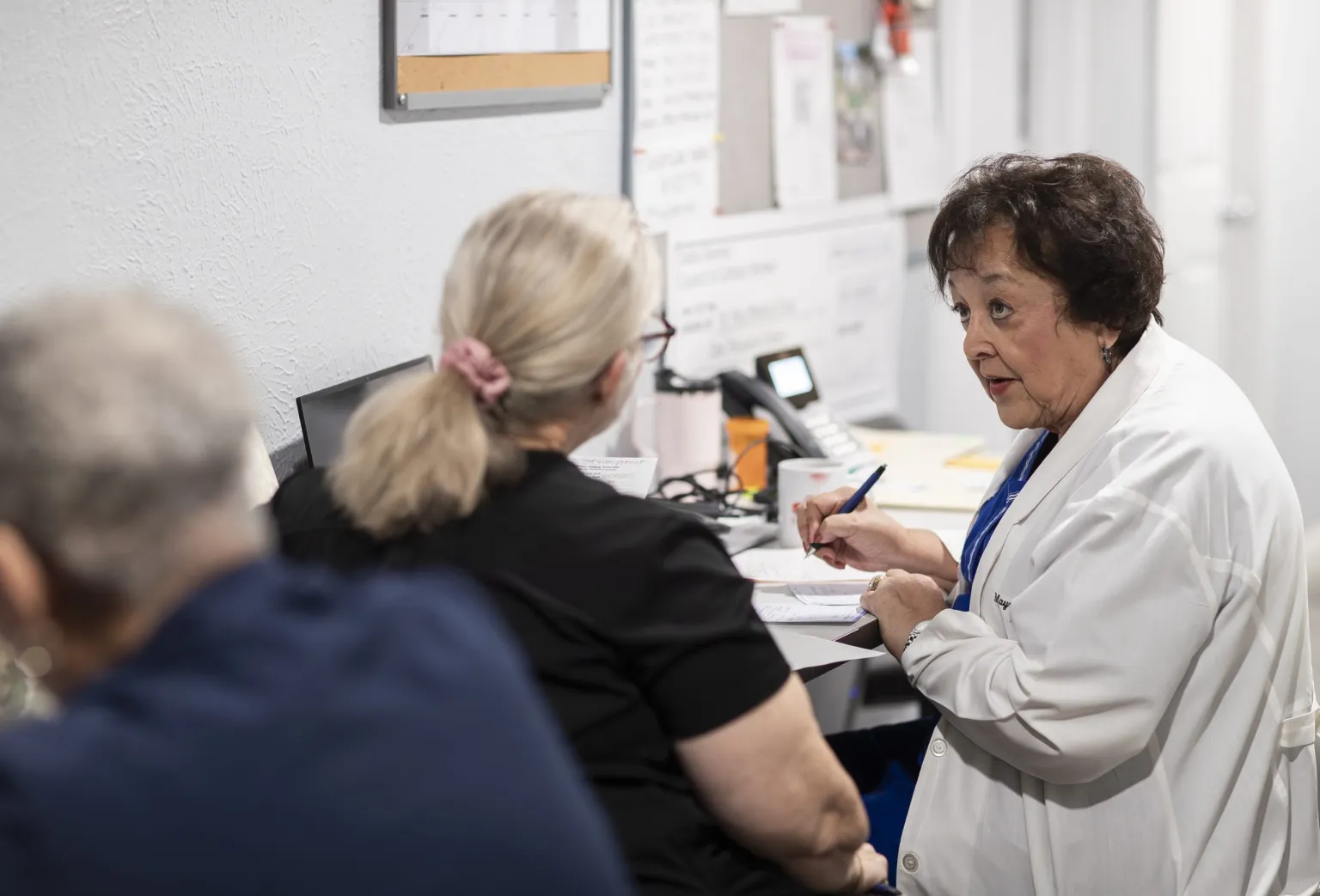
On a Wednesday morning at 8 a.m., 13 people gathered in a circle and bowed their heads. Dr. Jeff Thompson and his wife, Dr. Mayra Jimenez Thompson, thanked God for gathering them together at this single-story tan brick building in the South Dallas suburb of Lancaster, Tex., and blessed those who were about to arrive—a steady stream of the sick and suffering. Inside the modest 1,200-square-foot St. Paul Medical Clinic, patients moved smoothly from registration to being weighed and having blood drawn to checkups or follow-ups or minor surgery.
There was the woman with shingles, several people with diabetes, one person with a U.T.I., someone with hypertension and an older man with liver failure who was so gravely ill he looked like he might not make it through the day.
On every wall hung several crucifixes—20 in all, including a three-foot-long wooden cross near one of the clinic scales. Though several cases were a matter of life and death, the atmosphere was light and friendly, as translators, nurses and doctors calmly asked questions, prescribed drugs and cracked the occasional joke. When someone needed something, they barely had to shout to have a co-worker hear them and respond.
Leading the tight but graceful dance through three examination rooms and the tiny back office were the Drs. Thompson, the married couple who started this clinic in December 2023 to serve the uninsured and underinsured, many of whom are undocumented immigrants.
Many of the patients the Thompsons serve have unchecked diabetes. One diabetic patient, a social worker named Lorena Rosas, 45, was there to get the results of her tests from her last visit. After a bad experience at the bigger county hospital, she had come to the clinic over a year ago for the first time.
“I’m very blessed to have found them. They listen. They understand you. It’s more like they adopt you into their family,” she said, nodding. “It’s like home.”
Texas is one of 10 states that did not extend Medicaid under the Affordable Care Act in 2012, so over five million people are without health insurance here—the highest percentage (17 percent) in the nation. This tiny clinic offers a front-row seat to the looming health crisis expected to hit the rest of the country due to the Senate’s cuts to Medicaid, part of this year’s Big Beautiful Bill. Acting as doctors within borders, the Thompsons are at the forefront of the health care crisis in the United States, helping the walking wounded who have already arrived on their doorstep.
Devout Catholics who are both semi-retired, the Drs. Thompson have assembled 11 volunteer nurses, translators, technicians, office workers and a third doctor, who was on leave in Puerto Rico tending to her sick mother during my visit. They have contributed around $40,000 of their own money each year to keep things running three days a month with no direct financial assistance from the diocese but with dozens of donations of equipment, money, time and supplies from their large social and professional network in more affluent North Dallas.
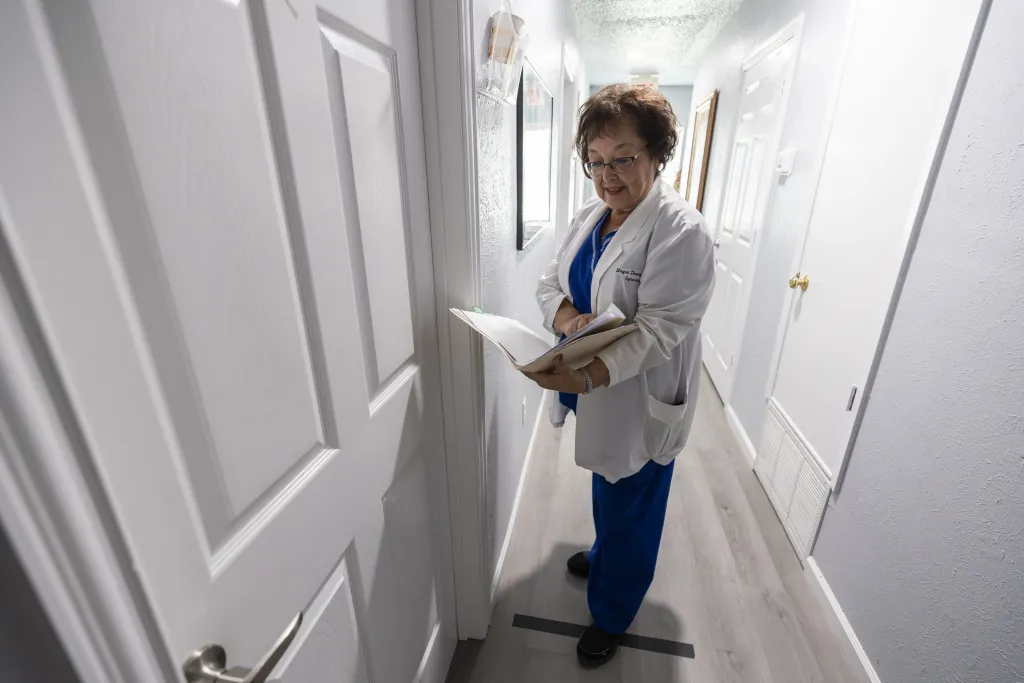
Mayra, a dynamic brunette with glasses, dressed in royal blue scrubs with a silver Jerusalem cross shining around her neck, said she and her husband got the idea for the clinic on a mission trip several years ago. While driving through Honduras, they noticed similarities to the neighborhoods in South Dallas. “I said, ‘Why are we doing mission trips and not helping people in our backyard?’” Mayra, 72, recalled.
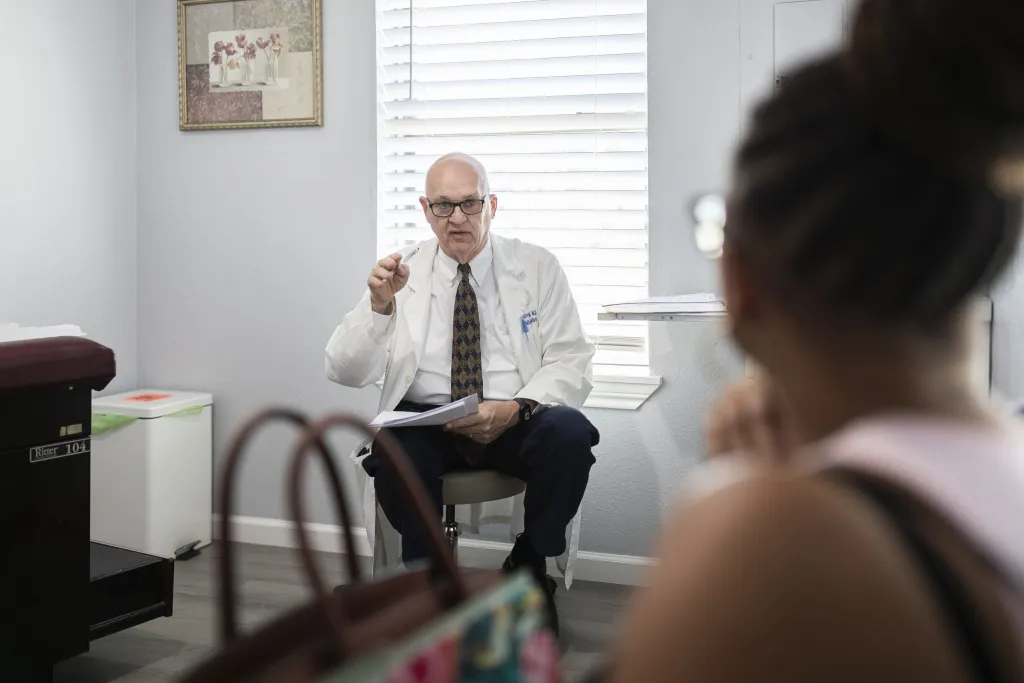
Her husband, Jeff, 68, dressed in a tie and lab coat, is quieter and more reserved, with a dry sense of humor. “I thought the whole thing was my idea, but you’d better ask Mayra,” he said, laughing. “It’s truly been a joint effort. We really couldn’t do it without each other. It’s a religious calling. We’re part of taking care of our fellow man. We’re in a position where we don’t need to work anymore for money, but we still have skills we can share.”
The Thompsons haven’t worked together since Jeff was in medical school at the University of Illinois in the 1980s, where Mayra was an intern and his supervisor. Mayra, who came to the United States from the village of Orizaba in Veracruz, Mexico, with her parents when she was 5, was the first to go to college in her family and eventually became an OB-GYN in Chicago, where she was raised. Her father worked for Ryerson Steel and ran a grocery store and a laundromat, where she helped fold clothes whenever she was not tending to patients.
“My father was the one who would always take the leap,” she said. “He told us, if you want something, go for it. And just remember, you are somebody. Don’t let anybody tell you you’re not.”
Jeff was from a conservative family of engineers from Bucks County, Pa., who bounced around from church to church, first Dutch Reform, then Methodist and finally evangelical. He was expected to go to engineering school when he grew up, but then his father died suddenly of a heart attack at age 38.
“We were on vacation in the middle of the Navajo Indian reservation in Arizona,” Jeff recalled. “The ambulance took him to the nearest city, but they couldn’t resuscitate him. That kind of changed things for me.” Jeff was only 11 years old.
His mother remarried and moved the family to Chicago. Jeff wound up applying to the University of Illinois, where Mayra was also studying. But they didn’t meet until his third year of medical school there in 1981, when he was on rotation and was assigned to Mayra’s OB-GYN team.
Though Jeff liked Mayra, Mayra was not so crazy about Jeff. “But he grew on me really because of his intelligence, his kindness and his morals.” Jeff was a very religious man, though he wasn’t yet Catholic. “But he truly had ethics, and I had met so many men without them. My background was very conservative and Catholic.”
Mayra began working as an OB-GYN in Chicago, and when he graduated, Jeff was assigned to Dallas to work in his chosen field, nephrology, a kidney specialist. Mayra didn’t want a long-distance relationship, but Jeff did, and won her over through marathon phone calls and long theological discussions. In 1983, he proposed in a 10-page handwritten letter. When Mayra finished her residency in 1984, they got married.
“You’ve seen ‘My Big Fat Greek Wedding’? That’s my family, except we’re Mexican,” Mayra said. She flew out to Dallas to be with Jeff, but the plan was to stay for only a year and then return to practice in Chicago. Nine months and six days later, they had their first of four children, Garrett. Jeff agreed to raise their children Catholic.
When Jeff was asked to teach at UT Southwestern Medical School in Dallas, they decided to stay. Jeff had a good position, and she was happy working as an OB-GYN at St. Paul, the only Catholic hospital in Dallas.
In addition to working as an OB-GYN, Mayra began doing radio spots in Spanish for the Mexican community. “She was a little famous, actually,” Jeff said, proudly. “One time, she wanted to see this Mexican nightclub singer from Dallas. We called at the last minute and used [Mayra’s] name, and we got the best table in the club.”
When Jeff finally entered the Catholic Church at the Easter Vigil Mass in 1998, his two eldest sons were altar servers. (The Thompsons now babysit regularly for their son Ronnie’s two children and pick them up from school two days a week, with car seats in the back of their Toyota Forerunner to prove it.)
Mayra took a job in a private practice. Jeff also went out on his own. Both had worked separately for many years at St. Paul Hospital, which changed hands and eventually closed in 2014 because of financial problems. In 2018, after a series of mission trips to Honduras, Mayra and Jeff were having dinner with Dallas’s new bishop, the Most Rev. Edward Burns, and wound up lamenting the lack of Catholic hospitals in the city. “Every little dinky town has a Catholic hospital in Texas,” Jeff said. But Dallas didn’t have one, he said, because the market is very competitive, with Baylor, Methodist, Presbyterian, UT Southwestern Medical School, Parkland Memorial and HCA Healthcare.
“Bishop Burns challenged us to do this,” Mayra said.
They decided to launch a clinic as an apostolate of the Medical Guild of Dallas. They did their homework, looking at demographic studies to find the neediest areas of Dallas, then visited clinics in Dallas, Houston, Fredericksburg, Round Rock and Memphis. The pandemic delayed their search for a space.
But then they met Luis Gonzalez, the chief executive officer of the Society of St. Vincent de Paul for North Texas, which runs an outreach center next door in the same building that provides a free pharmacy for the poor.
Introduced by a mutual friend, the three got together for lunch three years ago. “And we all fell in love with each other,” Mr. Gonzalez said. “I told them right off that there’s a space down here in Lancaster for them.”
And so here they are.
“When people walk in there, they are on the road to a bad, bad end,” Annette Gonzales Taylor, a friend from the Catholic community who was asked to join the clinic’s board, said. “[The Thompsons] diagnose them and get them treatment. And the partnership with St. Vincent de Paul is amazing. Together, literally, they have saved people’s lives.”
“They were willing to put their money where their mouth is. They ponied up,” Ms. Taylor said. “They’re just a dynamic duo, but in a quiet way. They’re not loud, ostentatious people. The Thompsons are an example of what’s good in the church and what’s good in the faith. It’s not only that they’re doing this good work, but they’re allowing other people to participate in this ministry.”

Because of Mayra’s enthusiasm, people from all over Dallas are willing to help, Mr. Gonzalez said. “Nobody can say no to her. She is a force of nature. When she stares you down, you have nowhere to go but to just say yes.”
They are unapologetically Catholic, Mayra said, meaning they do not refer women to abortion clinics, nor do they prescribe birth control. Each day starts with a staff prayer, and around 2 p.m. when they finish, the staff all hold hands again in a circle, bow their heads and say the Our Father.
Patients—no matter their religion or lack of religion—are charged a flat rate of $35, a sum the Thompsons say helps preserve the dignity of those they serve. “Also, if you say free clinic, the idea people get is a lousy clinic, a cheap clinic,” Jeff said. “And that’s not us.” Among the things they say are lacking are an electronic medical records system, radiology services and a hospital partner to refer patients for advanced, low-cost care.
On that Wednesday, in one examining room, Mayra removed a contraceptive implant from the arm of a young woman who had been complaining of weight gain and muscle aches. Jeff examined the man with liver disease. And the head nurse, Donna Beatty, was tracking down needles at Walmart for another patient’s injection pen.
Ms. Beatty, a retired operating room nurse who has worked with Mayra and Jeff for over two decades, said she did not hesitate for a moment when they asked her to volunteer. “I love their spirit, and they’re so easy to work with,” Ms. Beatty said. She not only helps diagnose patients before the doctors see them, but also helped set up the clinic, picking up equipment on Sunday nights with her husband, and helped put together their policies and procedures.
“There’s no drama here,” Ms. Beatty said. “We’re here to take care of people and do our best for them.” Because of the level of care, patients continue to come back. The clinic has 252 regular patients registered so far.
Lorena Rosas, the diabetes patient, finally got her results back that Wednesday morning. She said the change from her last appointment was dramatic. She said her blood glucose levels had been “so high I was told I could go into diabetic shock.” But after receiving medication from the Thompsons, her levels were close to normal limits, she said. “No one can believe how low my numbers are. It’s kind of a miracle.”
Our mission is to provide life-changing support to individuals and families in need, offering resources that bring stability and hope. Together, we can prevent homelessness, feed the hungry, and create sustainable futures.